
Sourcing Guides · The Anatolia Journal
Fabric Pilling Test Reports: A Practical Buyer's Checklist
Read the method, assessment stage and acceptance criteria before treating a surface-appearance grade as an approval.
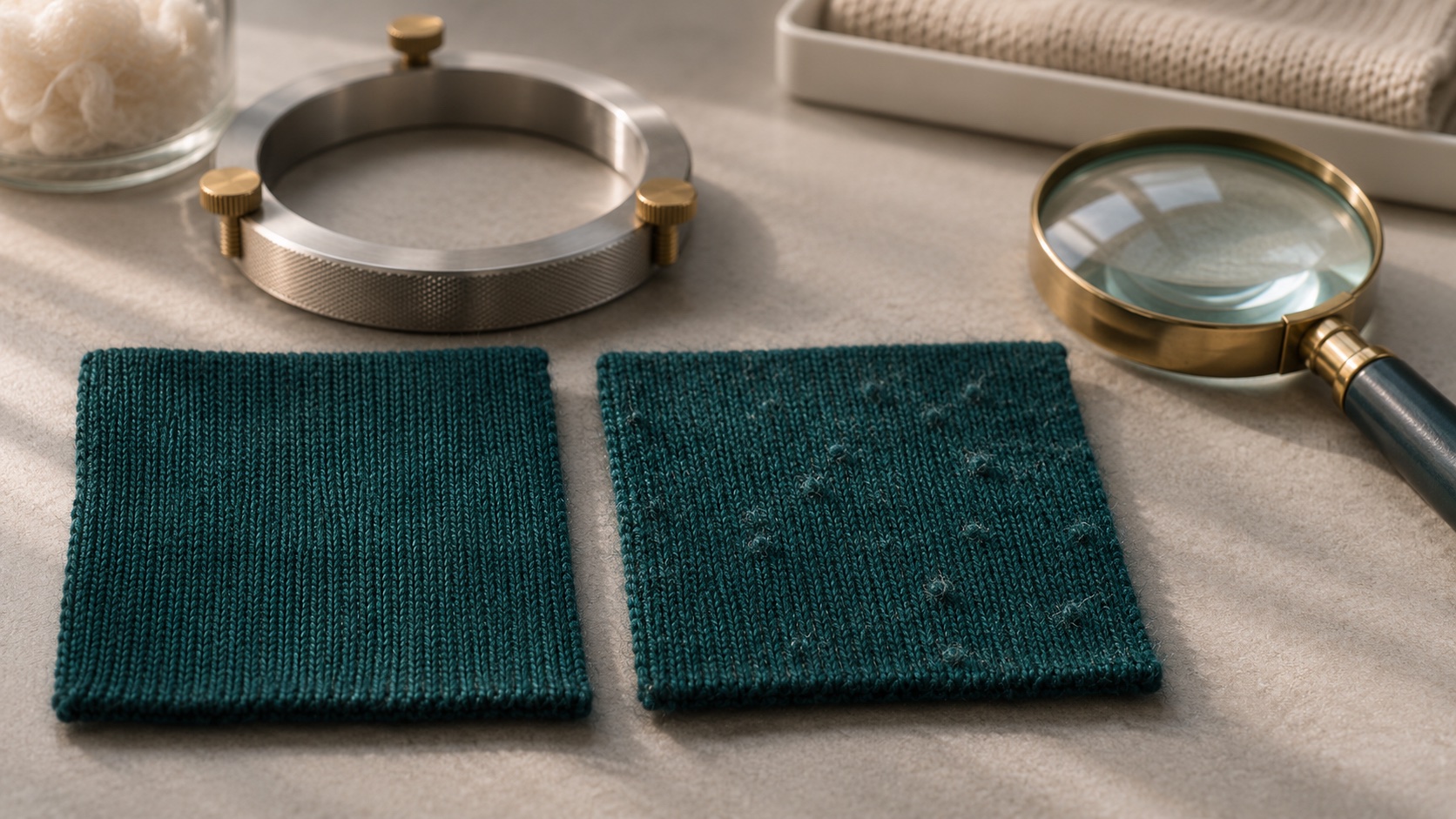
The key decision
A pilling grade needs its sample identity, method and assessment conditions before it can support a material decision.
A fabric swatch may feel right at development stage, yet a buyer still needs evidence about how its surface appearance has been assessed. A report saying only ‘pilling: 4’ leaves important questions unanswered: which material, which method, and at what assessment stage?
This guide helps apparel buyers review a pilling report and request missing information. It is a document-review workflow, not a substitute for a laboratory procedure or a promise about a garment’s appearance after a particular period of wear.
1. Read the full method reference
Ask for the named method, edition and any agreed deviations. For example, ISO 12945-2:2020 addresses fabric propensity to surface pilling, fuzzing or matting using a modified Martindale method. Confirm the appropriate current method and edition with the laboratory when commissioning the work.
Do not accept ‘Martindale tested’ as a complete description. UL Solutions distinguishes Martindale abrasion and pilling testing. A result from one assessment should not silently stand in for the other.
Keep the assessment endpoint visible. When two reports use different methods or assessment stages, ask the laboratory whether the results are comparable. Do not rank suppliers by a grade stripped from the conditions that produced it.
2. Match the tested specimen to the material being bought
Check the style or material reference, fibre composition, colour, construction, finish and submission date. Ask whether the tested sample came from a development length or a production lot, and record the lot identity where available.
If a finish or yarn changes after testing, review whether the old report still represents the current material. The sensible question is not whether a document already exists, but whether its sample identity and scope support the decision now being made.
Connect the report to a retained swatch and the material version in your development file. For a garment approval, keep it alongside the pre-production reference so the technical evidence and physical sample can be traced together.
3. Check the grading scale and the individual results
UL Solutions describes a pilling rating scale from 5, representing no or insignificant pilling, to 1, representing very severe pilling. Read the scale specified in your actual report and ask the laboratory how individual observations and the reported result were recorded.
A higher grade is not an automatic purchase approval. The buyer still needs an agreed requirement for this material and assessment stage. A number accepted for one product should not be copied into another order without a technical review.
If photographs are supplied, keep them associated with the relevant specimen and assessment stage. Use them as supporting evidence, not a reason to disregard the report’s defined visual assessment procedure. Phone images taken under different lighting are a weak basis for comparing borderline results.
4. Use a short evidence checklist
| Report field | What to check | Follow-up if missing |
|---|---|---|
| Sample identity | Material, colour, finish and relevant lot | Confirm which submitted fabric was tested |
| Method | Full reference, edition and deviations | Ask the laboratory to identify the procedure |
| Preparation | Any specified pretreatment and conditioning record | Clarify the state of the specimen tested |
| Assessment stage | Recorded exposure or assessment interval | Request the stage behind the grade |
| Result | Scale, observations and reporting basis | Ask how the reported grade was reached |
| Acceptance | Agreed criterion and authorised decision | Keep the material decision open |
This is a buyer’s evidence checklist rather than a list of universal mandatory report fields. Agree the actual reporting scope with the laboratory and technical team before testing, especially if the order has a named buyer testing protocol.
5. Decide what happens next
Set acceptance criteria before seeing the grade. Record the required method, assessment stage and result for the intended product. Avoid converting a laboratory exposure into a fixed number of months of customer wear unless a qualified specialist has established an appropriate basis for that claim.
- Record pass, hold or further-review status against the agreed requirement.
- Identify the material versions or lots covered by that decision.
- Assign an owner to any proposed material or finish revision.
- Specify what representative sample and evidence the revision needs.
- Retain both original and revised results with the approval record.
Keep different performance questions distinct. Dimensional change after laundering is another assessment, and fabric GSM is a material specification. Neither replaces a pilling review. Use the sampling process to resolve an unsuitable surface-appearance result before accepting the affected material for the next stage.
Common questions
Does a grade of 4 always mean the fabric passes?
No. Compare the result with the product's agreed acceptance criteria, named method and assessment stage. There is no universal pass grade in this buyer checklist.
Is a Martindale abrasion result also a pilling result?
Do not assume so. Ask for the full test reference and the specific property assessed. Abrasion and pilling results answer different questions.
Does a pilling test tell me how many months a garment will look new?
Do not make that claim from a laboratory grade alone. The report concerns the specified test conditions; any claim about actual wear needs an appropriate supporting basis.