
Sourcing Guides · The Anatolia Journal
Garment Tech Pack Checklist: What to Send Before Sampling
Turn a collection idea into a versioned set of instructions a sample room can review and question.
The key decision
A useful tech pack makes the known requirements explicit and the unresolved decisions visible before the first sample is requested.
A reference photograph communicates an idea, but it rarely answers every question needed to develop a garment. The sample room still needs to know the intended measurements, materials, construction and details that the photograph does not show.
A garment tech pack brings those instructions into one controlled document set. For a brand sourcing clothing from Turkey, the aim is a brief that can support a consistent sampling discussion, with clear questions where development input is still needed.
1. Put identity and revision control first
Give every style a unique reference, a descriptive name, the season or collection, a document date and a revision identifier. Put that identity on the relevant sheets and supporting files. State who owns the design decisions and who consolidates supplier questions.
Separate a development request from a production release. A first sample brief may contain open questions; mark them as open rather than presenting guessed details as approved requirements. A sample room should be able to see what it must follow and where it is being asked to propose a solution.
When a change is made, record what changed and which version supersedes the earlier one. A folder containing several files called ‘final’ makes it difficult to establish the current instruction. Use one short revision log that travels with the pack.
2. Show construction that a photograph cannot explain
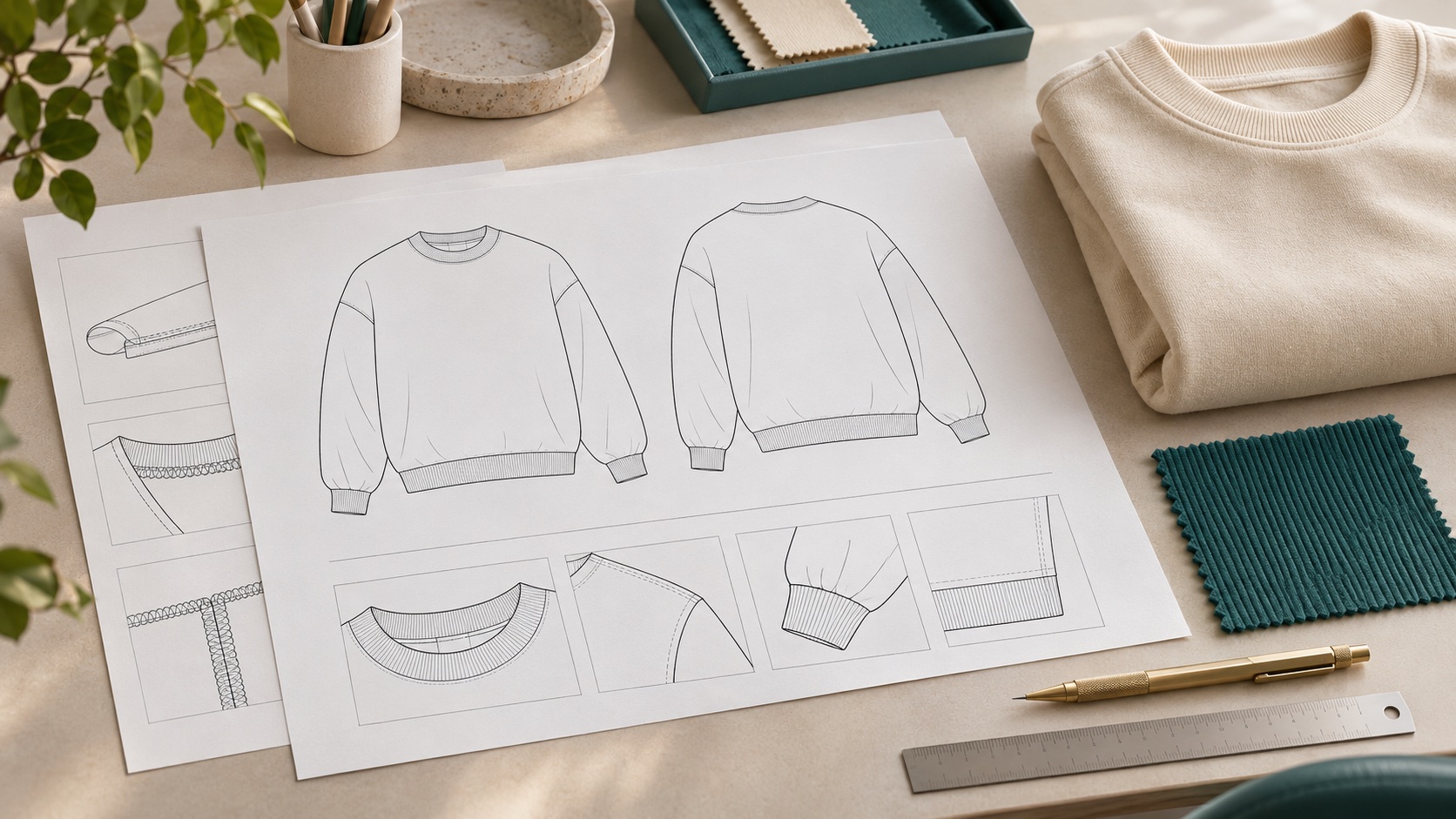
Include front and back technical drawings, plus enlarged detail views where needed. Call out pocket shape, openings, panels, seam positions, cuffs, closures and decoration placement. Distinguish a construction instruction from a visual inspiration image.
For every detail, ask whether the sample maker can identify its location, intended dimensions and material. If a stitch or seam has been specified by a technical designer, retain the exact reference and supporting sketch. If it has not been decided, request a recommendation and keep it open for review.
As an example of a working development document, Techpacker’s dress guide shows how sketches, measurements and material information are organised in a tech pack. The required detail still depends on your garment; a simple T-shirt and a lined jacket need different information.
3. Build a bill of materials with traceable references
List the main fabric, secondary fabrics, lining where relevant, rib, thread, closures, labels and other trims. Give each component a reference and state where it is used. Record composition, colour reference and the technical details already agreed with the supplier.
Keep unknowns visible. If the exact zip or fabric is still to be sourced, write the functional requirement and identify the next approval step. Do not turn an approximate reference into an approved component by copying it into a new sheet.
Connect colour submissions to the lab dip approval record. Link garment label artwork to the label artwork and placement checklist. Those separate references let the pack point to a controlled approval instead of reproducing an outdated image.
4. Make measurement instructions repeatable
A measurement chart needs more than a column of numbers. State the unit, the sample size and the named points of measure. Use drawings to show where the tape starts and ends, whether the garment is laid flat, and how any stretch or curved measurement is taken.
Have the technical team set the required dimensions, grading and tolerances for the product. Do not apply one tolerance to every measurement by habit. State whether the requirements refer to an unwashed garment, an after-wash garment or another specified condition.
| Pack element | Minimum question to answer | Common gap |
|---|---|---|
| Style identity | Which style and revision is this? | No version date |
| Technical drawings | Where and how is the detail constructed? | Only a front photograph |
| Materials list | Which component goes in each location? | A trim without a reference |
| Measurement chart | What is measured, in which unit and condition? | No measurement diagram |
| Open issues | Who must decide what before the next stage? | Comments scattered across messages |
5. Review the pack before requesting a sample
Ask a colleague or technical reviewer to read the pack without your verbal explanation. Note every question that stops them understanding the garment. Resolve those questions or list them explicitly for the supplier’s review.
- Confirm that drawings, materials and measurements refer to the same revision.
- Check that every attached artwork file has a matching reference.
- State the sample’s purpose and the decisions it should help resolve.
- Name the owner of each open issue.
- Request acknowledgement of the document version received.
- Retain a copy of the exact pack sent with the sample request.
Bring the pack into the sample development discussion. After the sample arrives, record comments against the same measurement points and detail references. That keeps the revision trail readable and prevents an accepted feature from being reopened by an old attachment.
Common questions
Do I need a complete production tech pack to ask for a first sample?
A development brief can contain unresolved items if they are clearly marked and assigned for review. State which details are requirements and which need technical or sourcing input.
Can a reference photo replace technical drawings?
Use it to explain design intent, but provide drawings and callouts for details the photo does not define. The sample maker needs explicit instructions for the required result.
Who should set garment measurement tolerances?
Have the brand's technical team or a qualified garment technician define appropriate requirements with the supplier. Tolerances should reflect the measurement, construction and agreed approval condition.