
Sourcing Guides · The Anatolia Journal
Cotton Garment Shrinkage Testing: A Buyer's Review Checklist
Turn a vague wash-test result into a clear decision on dimensions, fit and the next production step.
The key decision
Approve a documented wash-and-measure result for the intended garment, not a shrinkage percentage detached from its test conditions.
A T-shirt can meet its size specification before washing and still disappoint after the first few wears and washes. For a buyer sourcing cotton clothing from Turkey, the useful question is not simply whether the fabric has been tested. It is whether the result represents the material, finishing, garment construction and care routine being approved.
This guide is a buyer’s review workflow, not a laboratory test method. Agree the appropriate method with your technical team or testing laboratory, then use the checklist below to make the resulting report easier to interpret and act on.
1. Define what the report needs to answer
Start with the product and its intended care instructions. Record the style, fabric reference, fibre composition, colour, finishing route and sample stage. A development swatch and a finished garment answer different questions; label the evidence accordingly.
The public scope of AATCC TM150 describes assessment of garment length and width changes after home laundering. It includes alternative laundering parameters and notes limitations for some stretch fabrics. A method name alone therefore does not tell the buyer exactly which conditions were used.
Ask the laboratory to identify the method and edition, selected wash and drying procedure, number of cycles, specimen identification and any deviations. Do not substitute an informal office wash for a specified laboratory test when the order requires the latter.
2. Read length and width separately
Request the original measurements, the measurements after laundering and the calculated dimensional change for each relevant direction or garment measurement. Retain the units and the sign convention. Some reports express shrinkage as a positive reduction; others show dimensional change with a negative value. Confirm the convention before comparing results.
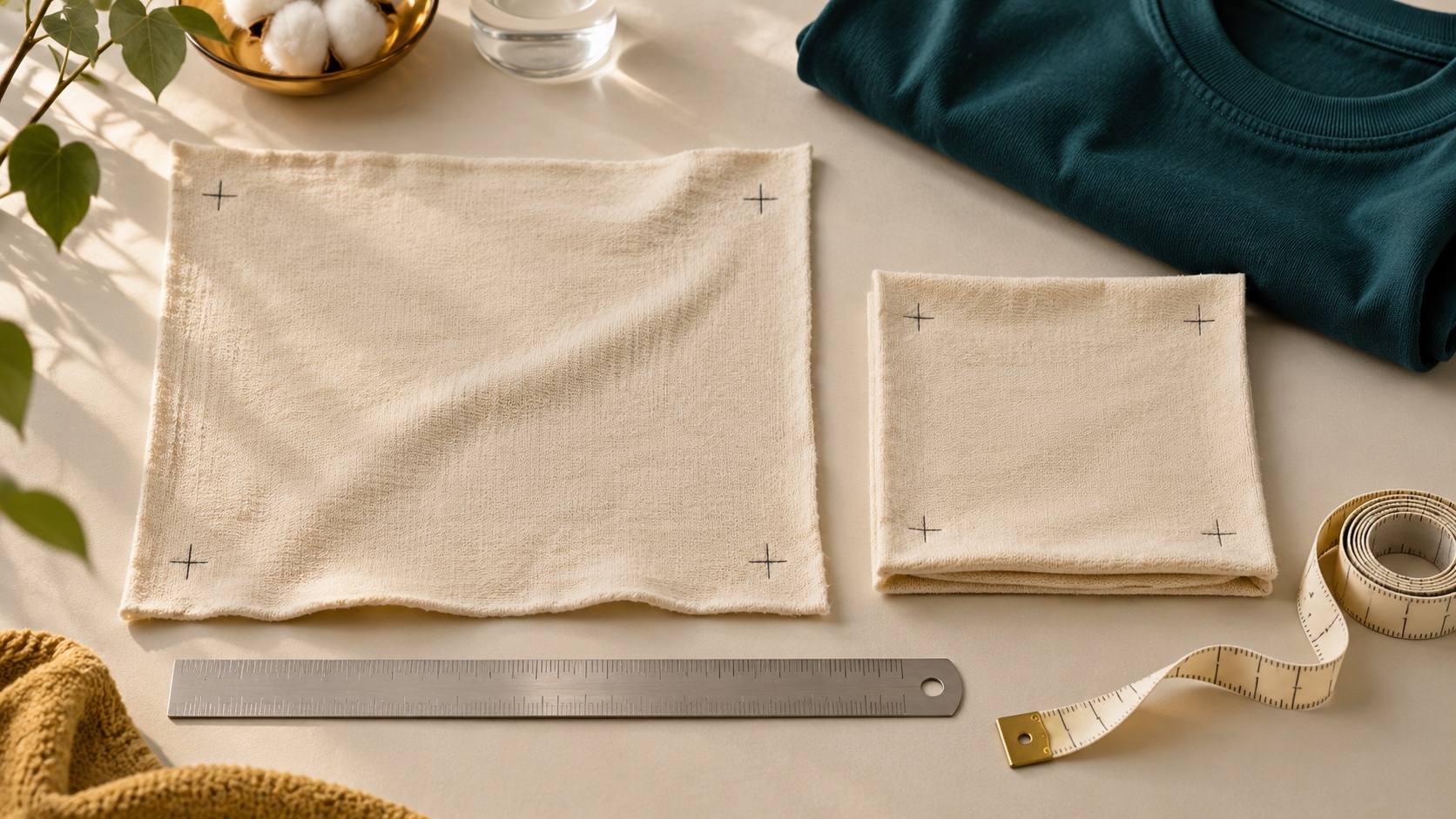
For a simple buyer-side arithmetic check, a measurement falling from 50 cm to 48.5 cm has reduced by 1.5 cm, or 3% of its starting value. This is an illustrative calculation, not a recommended pass limit. Do not average length and width into one reassuring number: a short body and a narrow chest create different fit problems.
Use the agreed garment measurement instructions consistently. Review how the sample was laid flat and where each measurement started and ended. If two teams measure different points, their results may disagree before laundering has even entered the picture.
3. Make the report traceable to the order
| Check | Evidence to request | Decision it supports |
|---|---|---|
| Sample identity | Style, colour, fabric lot and sample date | Whether the result belongs to the material under review |
| Care conditions | Method, washing, drying and cycle details | Whether two reports can be compared |
| Dimensions | Before, after and percentage change by measurement | Which areas affect the intended fit |
| Appearance | Consistent photographs and written observations | Whether a separate appearance issue needs review |
| Disposition | Pass, hold or revision against agreed criteria | Who may release the next stage |
Keep this evidence alongside your pre-production sample approval. A test report should be retrievable from the same style record as the physical approval reference, not buried in a separate message thread.
4. Agree limits around the product's fit
There is no useful universal shrinkage limit for every cotton garment. A close-fitting top, an oversized sweatshirt and a woven overshirt have different silhouettes and measurement priorities. Set the acceptance criteria before reviewing the result, including which points are assessed before washing and which must meet an after-wash specification.
CottonWorks’ shrinkage guidance explains that dimensional stability depends on choices throughout fabric and garment processing and recommends coordinated product engineering. Treat that as a reason to discuss the actual construction and finish, rather than select an arbitrary number from another product.
Also keep fabric weight in perspective. The GSM comparison guide covers weight selection; weight approval does not replace a dimensional-stability review.
5. Turn a failed result into a controlled revision
Put the relevant material or production decision on hold while the cause and proposed correction are reviewed. Ask what will change, which sample will represent that change, and what evidence will demonstrate the correction. A revised finish, material or pattern should have a clear version reference.
- Record the failing measurements and the agreed requirement.
- Identify the affected material, colour or batch; do not assume every version behaves identically.
- Assign an owner for the proposed correction and a new submission date.
- Repeat the agreed checks on the revised representative sample.
- Close the issue in writing before releasing the affected next step.
Avoid adding blanket pattern allowance without checking the resulting fit. That may move one measurement while leaving another problem unresolved. Discuss the revised sample through the sample development process and keep both the original and corrected results for comparison.
Common questions
Is a fabric shrinkage test enough to approve a finished T-shirt?
It is useful material evidence, but the approval plan should also consider the finished garment and its intended care. Confirm with the technical team which material and garment checks the order requires.
What shrinkage percentage should I accept?
Agree a product-specific limit before testing, taking account of fit and care. The numerical example in this guide demonstrates arithmetic only; it is not a pass threshold.
Can I compare reports using different drying procedures?
Do not treat them as directly equivalent. Ask the laboratory to explain the procedures and arrange comparable testing when the sourcing decision depends on the difference.