
Sourcing Guides · The Anatolia Journal
Private Label Clothing Labels: An Artwork and Placement Checklist
How to prepare a clear label brief, review a production proof and confirm where each label belongs before garments move into bulk production.
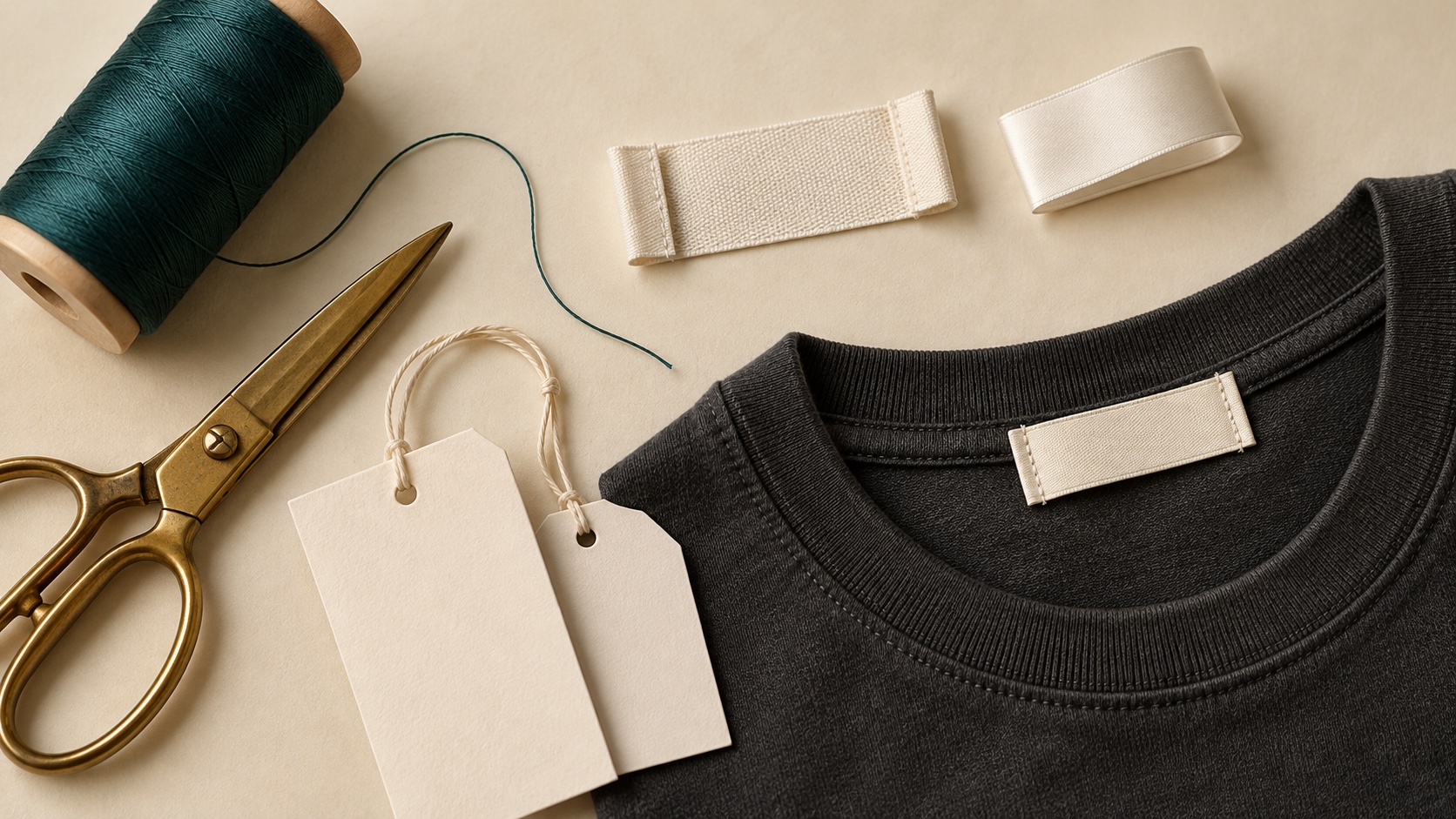
The key decision
Approve the label as a physical component attached to the garment, not only as a logo on a screen.
A private label collection needs more than a finished logo. The label has to be produced at the right dimensions, folded correctly and attached where you expect it. A neat digital proof can still leave those decisions unresolved.
This guide focuses on artwork and production coordination for clothing labels. It separates brand presentation from care information so your design brief does not accidentally become the source of unverified product instructions.
List the components separately
Begin by naming every component you expect to receive. Keep a main brand label, size identifier, care-information label and hangtag as separate items in the brief, even if the supplier proposes combining some of them.
For each item, state its purpose, material direction, finished dimensions, location and version. “All branding included” is too broad to show whether the supplier has allowed for every size or colour variant.
| Component | Decision to record |
|---|---|
| Main brand label | Artwork, finished size, fold and attachment method. |
| Size identifier | Size notation and whether it is separate or combined. |
| Care-information label | Approved product-specific content, language and attachment location. |
| Hangtag | Artwork versions, stock direction, hole position and fastening. |
Compare the scope with your private label production brief so labels and packaging are discussed together.
Send artwork at the intended physical size
Provide the original design file where available and a readable reference proof. Ask the supplier which file formats suit the proposed production method. Include the actual finished dimensions rather than only the pixel dimensions of a logo image.
Identify the front, reverse, orientation and any area that will disappear into a fold or seam. If a woven or printed proof changes the small details of the design, ask to review the physical result before accepting it.
Keep colour references explicit. Describe which part is the background and which part carries the artwork, and agree how colour will be reviewed. A screen image is a communication aid; it is not a substitute for a confirmed physical reference.
Use filenames that show component, version and date. One approved file should supersede the earlier versions so the factory does not have to choose between several near-identical attachments.
Show the fold and attachment on a garment drawing
A label’s finished size and its cut size may be different once folded. Ask the supplier to show both where relevant, along with the fold direction and the part intended for stitching. Confirm whether an edge is folded, sealed or enclosed in a seam.
Mark placement on a simple garment drawing and name the reference point. For a neck label, for example, show whether it is centred on the back neckline and how it relates to the neck seam. For a side label, identify the seam and orientation when worn.
Ask to see the label attached to the intended garment sample. Review comfort, visible stitching, readability and whether any content is hidden. A loose label on a table cannot demonstrate all of those points.
Confirm care information from the actual product
Brand graphics and care instructions serve different purposes. Do not copy a care label from a reference garment just because the products look similar. Ask who will confirm the content for your final materials, trims and finishing.
GINETEX explains that its symbols communicate textile-care treatments and that professionals are responsible for selecting appropriate treatments. Use that distinction when coordinating the brief: the designer can place the approved information, but the artwork alone cannot establish the correct care treatment.
Identify the intended sales markets and the person responsible for checking the applicable product information and language requirements. Keep that confirmation as its own approval item. This workflow is not a claim that one label layout satisfies every market.
Create a version map for sizes and styles
Prepare a small matrix showing which label version belongs to each style, size and relevant material variant. Check that the notation in the order, garment sample and label artwork agrees. If several styles share a brand label, record which information is shared and which remains product-specific.
Ask how the supplier will distinguish versions during attachment and packing. Review the sample from the outside and inside, then compare it with the matrix. Resolve inconsistencies before the labels are treated as ready for bulk use.
For the wider project sequence, see how our sourcing process works.
Approve one complete label reference
Make the approval record specific enough to reproduce. Identify the physical proof, artwork file and garment placement reference together. If an item remains provisional, mark it as pending rather than giving an unconditional approval.
- Every label and hangtag component listed.
- Current artwork version and physical dimensions confirmed.
- Material, colours, folds and attachment method reviewed.
- Placement checked on the intended garment sample.
- Size and style versions reconciled with the order.
- Care and product information approved by the responsible person.
- Any remaining decision has an owner and next step.
Use sample development to review the label in context before agreeing the final production reference.
Common questions
Do I need separate artwork for every size?
You need an unambiguous version for any component whose content changes by size. A shared main brand label and a separate size label may reduce artwork variants, but confirm the chosen arrangement in the brief.
Is a digital label proof enough for approval?
It can confirm content and layout, but a physical proof attached to the garment is useful for reviewing folds, stitching, scale and comfort.
Can I copy the care instructions from another garment?
Treat care content as product-specific. Ask the responsible technical or production contact to confirm the appropriate information for the actual materials and finishing.