
Sourcing Guides · The Anatolia Journal
Dry vs Wet Rubbing Fastness: What Clothing Buyers Should Check
Understand colour transfer under rubbing and keep dry and wet test results separate in your material approval.
The key decision
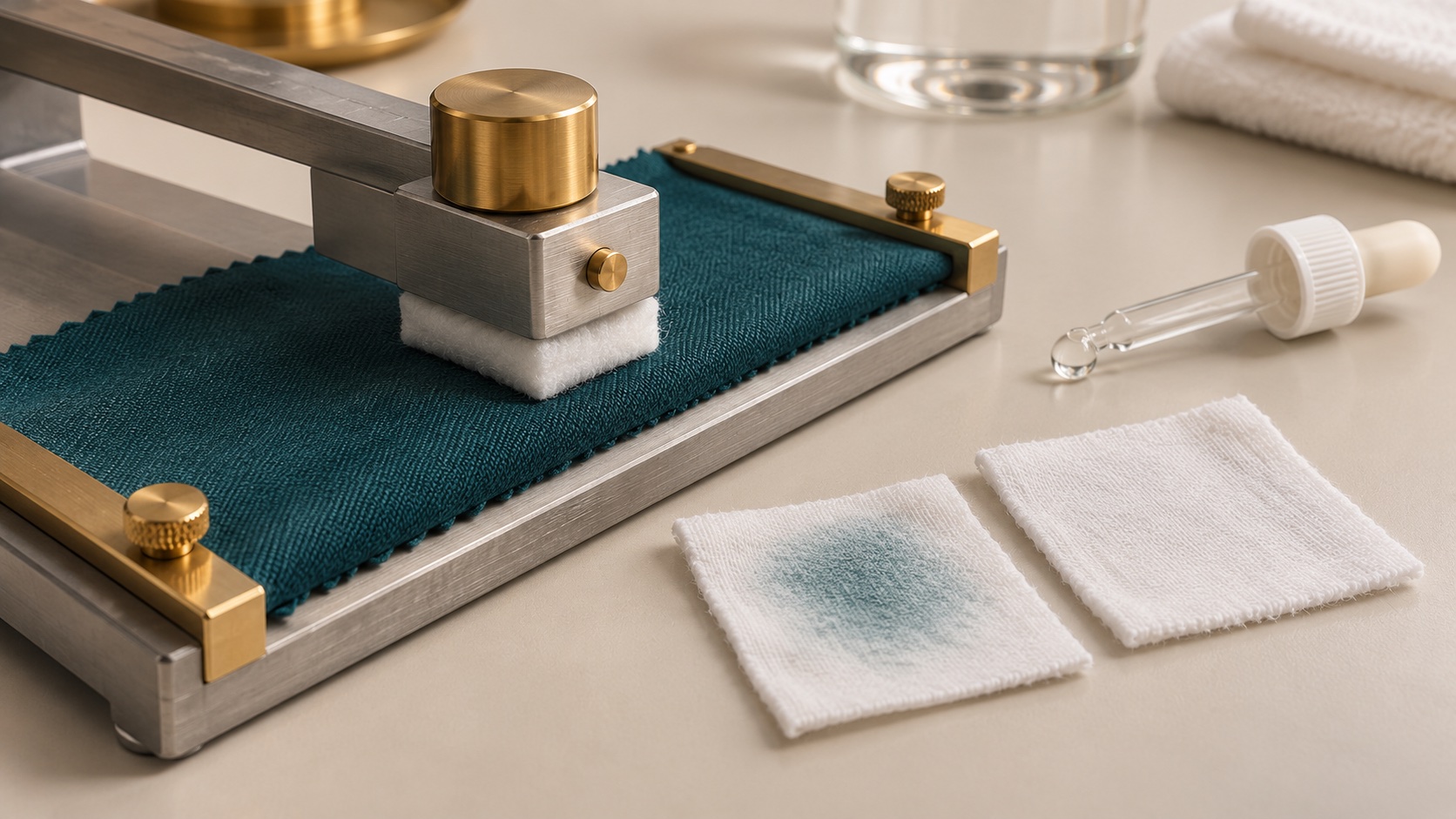
A matching shade does not establish rubbing fastness; review identified dry and wet results against the requirements agreed for the actual material.
A dark garment can match the approved colour reference while still raising a different question: how much colour transfers when its surface is rubbed? Colour approval and resistance to transfer are separate decisions.
This guide explains how clothing buyers can read dry and wet rubbing results and ask focused questions before accepting a fabric. It is a review guide, not an instruction for recreating a laboratory procedure with household materials.
1. Know what rubbing fastness assesses
The public scope of ISO 105-X12:2016 describes resistance of textile colour to rubbing off and staining other materials. It includes testing with dry and wet rubbing cloths.
AATCC TM8, titled Colorfastness to Crocking: Crockmeter, also describes controlled rubbing and assessment of colour transferred to a white test cloth. Its public summary identifies both dry and wet procedures.
Use the full method reference when requesting or reviewing a report. Do not assume that results carrying different method names are automatically interchangeable. Ask the laboratory which procedure and edition the order requires and how any difference affects comparison.
2. Read two results rather than one general claim
Check that the report identifies the dry and wet conditions separately. A statement such as ‘good colourfastness’ does not tell the buyer which result supports it or which acceptance criterion has been applied.
Ask the laboratory to explain the grading scale, assessment basis and any directions or specimen locations reported. Keep the actual results visible alongside the applicable requirement. Do not average a dry and a wet result into a new figure that obscures a failed condition.
| Question | Dry result | Wet result |
|---|---|---|
| Which condition was tested? | Confirm the dry rubbing procedure | Confirm the wet rubbing procedure |
| What was reported? | Retain the stated result and scale | Retain the stated result and scale |
| Which limit applies? | Use the agreed dry requirement | Use the agreed wet requirement |
| What is the decision? | Record pass, hold or review status | Record pass, hold or review status |
Agree the criteria for the intended product before testing. This guide does not set a universal passing grade or assume that every shade and material should use the same acceptance requirement.
3. Check the material and its treatment history
Record the fabric reference, colour, composition, finish and relevant lot or sample stage. A report for a development swatch should remain identified as development evidence; it should not silently become proof for an unrelated production batch.
AATCC’s public method summary notes that treatments such as washing and finishing can affect colour transfer and that testing can be performed before or after such treatment. Specify the condition needed for your order and ask the laboratory to identify the state of the sample actually tested.
If a material or finishing route changes, ask the technical team whether existing evidence still covers it. Keep photographs and retained swatches linked to the same reference so the buyer, supplier and laboratory can trace the submission being discussed.
4. Connect rubbing results to the right approval record
The lab dip workflow concerns the target shade and its approval reference. Passing that visual colour decision does not itself demonstrate resistance to colour transfer.
Likewise, do not use a dimensional-change report or a pilling assessment to close the rubbing-fastness question. They cover different properties. Keep each required check in the style’s test plan, with its own result and release decision.
Review the intended garment combination when deciding what evidence to request. A dark panel next to a pale component may prompt questions that a single-colour swatch does not raise. Have the technical team define any additional assessment needed for the product rather than inventing a conclusion from the cover image or an informal rub demonstration.
5. Make an unsatisfactory result actionable
- Identify the failed condition and the agreed requirement.
- Confirm the sample, colour, finish and lot covered by the result.
- Ask the supplier to describe the proposed corrective change.
- Define the representative revised submission and repeat checks.
- Review any affected shade, handle or other product requirements again.
- Record the authorised decision before the affected release point.
Do not describe a proposed treatment as a guaranteed fix. Request evidence from the revised representative material and keep the original result for comparison. The sample development process is the place to settle these open material questions before they are carried into a wider order.
When the result is accepted, state its scope clearly. Record the exact material and condition approved, the report reference and the decision owner. That gives the next person reviewing the order a usable answer instead of a general claim about colour quality.
Common questions
Is rubbing fastness the same as colour matching?
No. Shade approval compares colour with a reference. Rubbing fastness assesses colour transfer under a specified rubbing procedure. Keep both decisions visible when the product requires them.
Can a dry result replace the wet result?
Only follow the testing scope agreed for the order. If both conditions are required, retain and assess both separately rather than treating one as evidence for the other.
Can I use a home rubbing demonstration instead of the laboratory report?
It may help communicate a concern, but it does not establish compliance with a named test method. Use the agreed laboratory procedure and identified sample for the formal review.